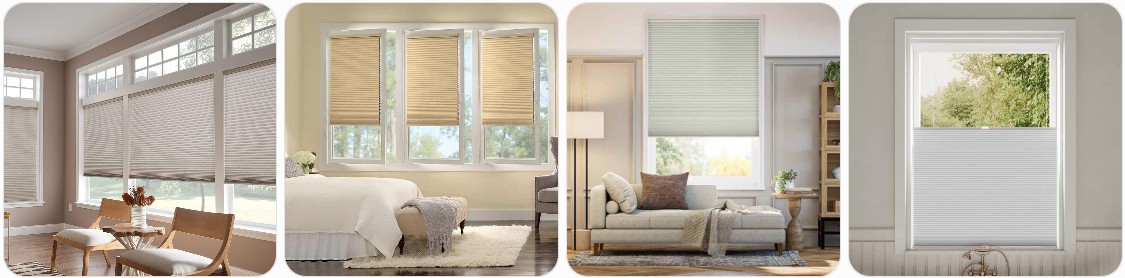
Honeycomb blinds are one of the best window-covering choices if you want insulation, privacy, soft light control, and a clean modern look. This buying guide explains how honeycomb blinds work, where to buy them online or locally, what they usually cost, their pros and cons, and what to check before ordering.
- Table of Contents:
- Honeycomb Blinds At a Glance
- What Are Honeycomb Blinds? How Honeycomb Blinds Work?
- Honeycomb Blinds Pros and Cons
- Honeycomb Blinds Cost
- Where to Buy Honeycomb Blinds Online
- How to Find Honeycomb Blinds Stores Near You
- What to Check Before Buying Honeycomb Blinds
- Honeycomb Blinds Installation Options
- FAQ About Honeycomb Blinds
Honeycomb Blinds At a Glance
- Best for: Bedrooms, living rooms, nurseries, offices, media rooms, street-facing windows, and rooms that need better insulation.
- Main benefit: The cellular pocket design traps air, helping reduce heat transfer through the window.
- Common styles: Light filtering, blackout, cordless, top-down bottom-up, motorized, single-cell, double-cell, and custom-size honeycomb blinds.
- Typical price range: About $25 to $150 per ready-made blind, while custom honeycomb blinds can range from about $80 to $400+ per window depending on size and options.
- Light control: Available in sheer, light filtering, room darkening, and blackout fabrics.
- Privacy level: Very good, especially with opaque or blackout cellular fabrics.
- Installation difficulty: Easy to moderate for standard windows; professional fitting may be better for oversized, high, bay, or specialty windows.
- Maintenance: Usually simple, but the pleated cells need gentle cleaning to avoid crushing or creasing the fabric.
- Best upgrade: Cordless or top-down bottom-up operation, because it improves safety, appearance, privacy, and everyday convenience.
- Watch out for: Incorrect measurements, cheap lift mechanisms, limited return policies on custom sizes, and fabric that does not match your light-control needs.
What Are Honeycomb Blinds? How Honeycomb Blinds Work?
What Are Honeycomb Blinds?
Honeycomb blinds are fabric window coverings made with pleated cells that form a honeycomb-shaped structure when viewed from the side. They are also commonly called cellular shades or cellular blinds. Unlike Venetian blinds or vertical blinds, honeycomb blinds do not use hard slats. Instead, they use soft folded fabric that stacks neatly when raised and expands into structured air pockets when lowered.
The main reason people choose Honeycomb Blinds is insulation. The hollow cells create small air chambers between the room and the glass. This design can help reduce heat gain in warm weather and heat loss in cold weather, making the room feel more comfortable. They are also popular because they look simple and modern, fit many interior styles, and come in several light-control levels.
Honeycomb blinds are especially useful for bedrooms, nurseries, offices, and living rooms where you want privacy without making the window look heavy. Light filtering honeycomb blinds soften sunlight and reduce glare, while blackout honeycomb blinds are better for sleeping areas and media rooms. If you want a cleaner setup, cordless honeycomb blinds remove dangling cords and give the window a neater appearance.
You can find many versions online, including cordless honeycomb blinds, blackout honeycomb blinds, and top-down bottom-up honeycomb blinds. These styles are worth comparing before you buy because the fabric opacity, cell size, control system, and mounting style all affect how the blind performs.
How Honeycomb Blinds Work?
Honeycomb blinds work by raising and lowering a pleated fabric shade inside a headrail system. When the blind is lowered, the fabric opens into rows of cells. These cells create pockets of trapped air. Because air is a poor conductor of heat compared with glass or metal, the cellular structure helps slow down heat transfer around the window area.
The simplest honeycomb blinds lift from the bottom and stack upward. More advanced versions use a top-down bottom-up system, which means the shade can lower from the top, raise from the bottom, or cover only the middle of the window. This is useful when you want daylight from the top of the window while still blocking the lower part for privacy.
Honeycomb blinds can use different control systems. Corded versions use pull cords, cordless versions lift by hand from the bottom rail, continuous cord loop versions use a looped chain or cord, and motorized honeycomb blinds use a remote, wall switch, rechargeable battery, or smart-home control. For most homes, cordless is the most practical choice because it looks cleaner and is safer around children and pets.
The performance of a honeycomb blind depends on the fabric, cell structure, and fit. Single-cell honeycomb blinds have one layer of cells and are usually lighter and more affordable. Double-cell honeycomb blinds have two rows of cells and may provide better insulation, but they can cost more and may have a slightly thicker stack when raised. A snug inside mount can help reduce light gaps, while an outside mount can cover more of the window frame and improve privacy.

BlindsAvenue Cordless Cellular Shade, White, 27" W x 72" H

No Drill No Tools Blackout Cellular Shades,Cordless Blinds for Indoor Windows,Room Darkening Window Shades Honeycomb Blinds for Bedroom,Office,Home,White,34.5" w x 64" h

LazBlinds Cordless Cellular Shades, 34'' W x 64'' H, White
Honeycomb Blinds Pros and Cons
Pros of Honeycomb Blinds
- Good insulation: Cellular pockets help reduce heat transfer around windows.
- Soft modern look: The fabric design looks clean, simple, and less bulky than many traditional blinds.
- Great privacy: Opaque and blackout fabrics block outside views well.
- Light filtering options: You can choose soft daylight, room darkening, or blackout coverage.
- Energy comfort: They can help make rooms feel warmer in winter and cooler in summer.
- Quiet operation: No hard slats clattering against the window.
- Child-safe options: Cordless honeycomb blinds are widely available.
- Top-down bottom-up option: Excellent for privacy while still letting daylight in.
- Works in many rooms: Suitable for bedrooms, living rooms, offices, nurseries, and dining rooms.
- Custom sizing available: Good choice for awkward window sizes when ready-made blinds do not fit.
Cons of Honeycomb Blinds
- Can cost more than basic blinds: Usually pricier than simple vinyl mini blinds or basic roller blinds.
- Fabric can stain: Not always the best choice for greasy kitchens or very damp bathrooms.
- Cells can collect dust: Dirt may settle inside or along the pleats.
- Not ideal for heavy scrubbing: The fabric needs gentle cleaning.
- Light gaps are possible: Inside mounts can leave narrow side gaps, especially with blackout fabrics.
- Cheap versions may sag: Low-quality lift systems can become uneven over time.
- Custom orders may be non-returnable: Always check the return policy before ordering made-to-measure blinds.
- Less adjustable than slatted blinds: You cannot tilt slats to fine-tune light direction.
Honeycomb Blinds Cost: What Price Should You Expect?
Honeycomb blinds usually cost more than basic mini blinds but less than many premium Roman shades or fully motorized smart blinds. For a standard ready-made honeycomb blind, expect to pay around $25 to $150 per window. Smaller light filtering versions are often at the lower end, while blackout, cordless, wider, or top-down bottom-up versions usually cost more.
Custom honeycomb blinds are more expensive because they are made to fit your exact window size. A made-to-measure honeycomb blind may cost around $80 to $400+ per window, depending on width, height, fabric type, cell structure, lift system, brand, and whether you add upgrades. Large windows, patio doors, double-cell fabrics, blackout materials, and motorized controls can push the price higher.
Installation can also affect the final cost. DIY installation may only require basic tools and the included brackets. Professional installation may add around $50 to $150+ per window, depending on your location, window size, and job complexity. If you are ordering several blinds at once, some installers may charge a lower per-window rate.
To estimate your budget before buying, use the Blind Cost Estimator and compare the result with real product prices. This is especially helpful if you are choosing between ready-made honeycomb blinds, custom honeycomb shades, cordless upgrades, and professional fitting.
Here is a simple pricing guide:
- Budget ready-made honeycomb blinds: About $25 to $60 per blind.
- Mid-range cordless honeycomb blinds: About $60 to $150 per blind.
- Top-down bottom-up honeycomb blinds: About $80 to $250 per blind.
- Blackout honeycomb blinds: About $50 to $250 per blind depending on size and brand.
- Custom honeycomb blinds: About $80 to $400+ per window.
- Motorized honeycomb blinds: About $200 to $700+ per window depending on motor, size, and smart features.
- Professional installation: Often around $50 to $150+ per window, or a project-based rate for multiple windows.
Where to Buy Honeycomb Blinds Online
Amazon is a convenient place to buy honeycomb blinds if you want ready-made sizes, fast comparison, customer reviews, and a wide range of styles. It is especially useful for standard windows where you do not need exact custom sizing. You can compare cordless honeycomb blinds, blackout cellular shades, light filtering shades, temporary cellular shades, and top-down bottom-up options in one place.
When buying honeycomb blinds from Amazon, pay close attention to the exact width and length. Some listings show the actual blind width, while others show the window opening size the blind is meant to fit. Also check whether the blind is designed for inside mount, outside mount, or both. For bedrooms, search for blackout cellular shades. For living rooms and offices, light filtering honeycomb blinds may be more comfortable because they soften daylight without making the room too dark.
Amazon is also useful for accessories and related items, such as cellular shade brackets, honeycomb blind repair kits, and blind installation tools. Before ordering, read recent reviews and check for comments about lift quality, fabric thickness, actual color, and ease of installation.
Find Honeycomb Blinds from Amazon »
BlindsAvenue Cordless Cellular Shade, White, 27" W x 72" H
No Drill No Tools Blackout Cellular Shades,Cordless Blinds for Indoor Windows,Room Darkening Window Shades Honeycomb Blinds for Bedroom,Office,Home,White,34.5" w x 64" h
LazBlinds Cordless Cellular Shades, 34'' W x 64'' H, White
eBay can be a good place to buy honeycomb blinds if you are looking for discounted, surplus, open-box, discontinued, or custom-made options. You may find branded cellular shades at lower prices than retail, especially if the size and color match your window. eBay can also be helpful when you need replacement parts for older honeycomb blinds, such as brackets, cord locks, rails, or repair kits.
When buying honeycomb blinds from eBay, check the seller rating, return policy, shipping cost, and item condition. If the blind is listed as used, open-box, or new old stock, ask whether all brackets and mounting hardware are included. For custom or cut-to-size blinds, confirm the exact finished width and height before ordering because returns may be limited.
Find Honeycomb Blinds from eBay »
Other online websites where you can buy honeycomb blinds include:
- Blinds.com – Good for custom honeycomb shades, fabric choices, cordless upgrades, blackout options, and made-to-measure ordering.
- SelectBlinds – Offers custom cellular shades with options such as top-down bottom-up, cordless lift, blackout fabric, and motorization.
- The Home Depot – Useful for ready-made and custom cellular shades, plus in-store help and installation services in many areas.
- Lowe’s – Good for comparing stock honeycomb shades, custom ordering, cordless options, and local pickup availability.
How to Find Honeycomb Blinds Stores Near You
To find honeycomb blinds stores near you, start by searching for local blind shops, window treatment stores, home improvement stores, and interior design showrooms. Use search phrases like “honeycomb blinds near me,” “cellular shades near me,” “custom honeycomb blinds near me,” or “window blinds store near me.” You can also check this helpful window blinds buying guide if you want more ideas on where to shop locally and online.
Local stores can be especially useful if you want to see fabric samples in person. Honeycomb blind colors can look different depending on lighting, wall color, and the direction your window faces. A physical store may also let you compare light filtering vs blackout fabrics, single-cell vs double-cell construction, and different lift systems before you order.
When checking local stores, ask whether they offer measuring and installation services. Honeycomb blinds need accurate measurements, especially for inside mounts. If your window is slightly out of square, has shallow depth, or needs a blackout fit, a professional measurement can prevent ordering mistakes. Local installers may also be better for large windows, bay windows, high windows, rental properties, offices, or multi-room projects.
Good places to look locally include:
- Independent blind and shade shops: Often best for custom honeycomb blinds and personal fitting advice.
- Home improvement stores: Good for budget-friendly ready-made cellular shades and basic custom ordering.
- Interior design stores: Better for premium fabrics, coordinated room styling, and higher-end window treatments.
- Local curtain and drapery shops: Many also sell cellular shades and can help match blinds with curtains.
- Window treatment installers: Useful if you already know the style you want but need measuring and fitting.
What to Check Before Buying Honeycomb Blinds
- Measure width and height carefully: Measure each window separately. Do not assume similar windows are exactly the same size.
- Choose inside mount or outside mount: Inside mount looks cleaner, but outside mount can cover more glass and reduce light gaps.
- Check window depth: Inside mount honeycomb blinds need enough frame depth for the headrail and brackets.
- Pick the right fabric opacity: Light filtering is good for living spaces, while blackout is better for bedrooms, nurseries, and media rooms.
- Compare single-cell vs double-cell: Single-cell is usually cheaper and lighter. Double-cell may offer better insulation but costs more.
- Look at the lift system: Cordless is clean and child-safe. Top-down bottom-up gives better privacy control. Motorized is convenient but expensive.
- Check the finished blind size: Some products deduct width automatically for inside mount, while others require you to enter the exact finished size.
- Review return rules: Custom honeycomb blinds are often non-returnable unless there is a manufacturing defect.
- Check hardware included: Make sure brackets, screws, handles, and installation instructions are included.
- Read reviews about sagging: Uneven lifting or sagging can happen with cheaper mechanisms, especially on wide blinds.
- Consider room moisture: Honeycomb fabric is not always ideal for very humid bathrooms unless the product is rated for that use.
- Think about cleaning: Choose a fabric and color that can handle dust, fingerprints, and everyday use.
- Check color from samples if possible: Online photos may not show the exact shade, texture, or light-filtering effect.
- Plan for light gaps: Blackout honeycomb blinds can still leak light around the edges unless measured and mounted carefully.
- Match the style to the room: White and neutral honeycomb blinds are versatile, while darker colors may show dust or absorb more heat.
Honeycomb Blinds Installation Options: DIY vs Professional Fitting

Cutelec 2pcs Box Mounting Bracket for Low Profile Horizontal Blinds with 1-3/4" x 2 1/2" Headrail - White Color

Jetec 6 Pieces Mini Blind Brackets for Window Blinds,1.18x1.18 Inch
Honeycomb blinds can often be installed as a DIY project, especially if you are fitting standard-size blinds on regular rectangular windows. Most products include brackets, screws, and basic instructions. For a typical inside mount, you mark the bracket positions inside the window frame, drill pilot holes, attach the brackets, and snap the headrail into place. For an outside mount, you attach the brackets above or around the window frame so the blind overlaps the opening.
DIY installation is usually the cheaper option. It works well when your window is easy to reach, your measurements are accurate, and the blind is not too wide or heavy. You will usually need a tape measure, pencil, level, drill, screwdriver, and sometimes wall anchors. If you are comfortable using basic tools, a single honeycomb blind can often be installed without hiring a professional.
Professional fitting is better when the job is more complicated. Consider hiring an installer if you have large windows, tall windows, bay windows, skylights, shallow frames, uneven frames, masonry walls, or many blinds to install at once. Pro fitting is also useful for blackout honeycomb blinds because careful placement can reduce edge gaps and improve room-darkening performance.
Here is a simple comparison:
- DIY installation cost: Usually free if you already have basic tools.
- DIY best for: Standard windows, small to medium blinds, ready-made sizes, and simple inside or outside mounts.
- DIY downside: Measurement mistakes, crooked brackets, or shallow frame issues can cause poor fit.
- Professional installation cost: Often around $50 to $150+ per window, depending on the installer and project size.
- Professional best for: Custom blinds, large windows, multi-window projects, blackout setups, motorized shades, and awkward window shapes.
- Professional downside: Adds to the total cost and may require scheduling an appointment.
If you install honeycomb blinds yourself, do not force the headrail into the brackets. The fabric cells can crease if handled roughly, and the headrail can bend if pressed unevenly. Always test the shade slowly after installation to make sure it raises evenly, locks correctly, and does not rub against the window frame.
FAQ About Honeycomb Blinds
Are honeycomb blinds the same as cellular shades?
Yes. Honeycomb blinds and cellular shades usually refer to the same type of window covering. Both names describe fabric blinds with honeycomb-shaped air pockets designed for insulation, privacy, and soft light control.
Are honeycomb blinds good for insulation?
Yes. Honeycomb blinds are one of the better blind styles for insulation because the cellular pockets trap air between the room and the window. They can help improve comfort in rooms that feel too hot, too cold, or drafty.
Do honeycomb blinds block light?
It depends on the fabric. Light filtering honeycomb blinds soften daylight but do not fully darken the room. Blackout honeycomb blinds block much more light and are better for bedrooms, nurseries, and media rooms.
Are honeycomb blinds good for bedrooms?
Yes. Honeycomb blinds are a strong bedroom choice because they provide privacy, insulation, and soft styling. Choose blackout honeycomb blinds if you want better darkness for sleeping.
What is the difference between single-cell and double-cell honeycomb blinds?
Single-cell honeycomb blinds have one row of air pockets, while double-cell honeycomb blinds have two rows. Double-cell styles may offer better insulation, but they usually cost more and may stack thicker when raised.
Are cordless honeycomb blinds worth it?
Yes, cordless honeycomb blinds are usually worth it for most homes. They look cleaner, remove dangling cords, and are safer for homes with children or pets. They are also easier to use on many everyday windows.
Can honeycomb blinds be installed inside the window frame?
Yes. Honeycomb blinds can be installed as an inside mount if the window frame has enough depth for the headrail and brackets. Inside mount gives a neat built-in look, but it may leave small side light gaps.
Can honeycomb blinds be installed outside the window frame?
Yes. Outside mount honeycomb blinds are installed above or around the window frame. This can help cover more glass, improve privacy, hide uneven frames, and reduce light gaps compared with some inside mounts.
Are honeycomb blinds good for bathrooms?
Honeycomb blinds can work in powder rooms or well-ventilated bathrooms, but they are not always the best choice for very damp spaces. Moisture can affect some fabrics, so check whether the product is suitable for humid rooms before buying.
How do you clean honeycomb blinds?
Use a feather duster, vacuum with a soft brush attachment, or gentle compressed air to remove dust. Avoid soaking the fabric or scrubbing hard because the pleated cells can crease, stain, or lose shape.
Do honeycomb blinds reduce noise?
Honeycomb blinds may slightly soften outside noise because of their fabric and air-cell structure, but they are not soundproof. They can help make a room feel quieter, but they will not block traffic or loud neighborhood noise completely.
Are honeycomb blinds better than roller blinds?
Honeycomb blinds are usually better for insulation and soft privacy, while roller blinds are often simpler, cheaper, and easier to wipe clean. The better choice depends on whether insulation, price, cleaning, or appearance matters most.
Do honeycomb blinds look modern?
Yes. Honeycomb blinds have a clean, simple, fabric-based look that works well in modern homes, minimalist rooms, offices, and bedrooms. Neutral colors such as white, cream, gray, and beige are especially versatile.
Can honeycomb blinds be repaired?
Some honeycomb blind problems can be repaired, such as broken cords, loose brackets, uneven lifting, or damaged hardware. However, crushed fabric cells, severe staining, or broken internal mechanisms may be harder to fix.
How long do honeycomb blinds last?
Good-quality honeycomb blinds can last several years with gentle use and regular dusting. Lifespan depends on fabric quality, lift system, sun exposure, humidity, and how often the blind is raised and lowered.
Summary
Honeycomb blinds are a smart choice if you want window coverings that improve privacy, soften light, and help with room comfort. Their cellular design makes them especially useful for insulation, while cordless, blackout, top-down bottom-up, and custom options make them flexible for different rooms. They usually cost more than basic mini blinds, but the comfort, cleaner appearance, and energy-saving potential can make them worth the price.
For most buyers, the best approach is to measure carefully, decide between light filtering and blackout fabric, choose cordless if possible, and compare ready-made vs custom sizing. Amazon and eBay are useful for online deals and standard sizes, while custom blind websites and local stores are better for exact fit, fabric samples, and professional installation. If your windows are unusual, large, or difficult to reach, professional measuring and fitting can help you avoid expensive mistakes.

60 PCS Vertical Blind Repair Tabs Kit Clear Fixer Verticle Blinds Snap in Replacement Slats Parts Panels
SOGEWO (16 Set/32 Pieces) Clear Vertical Blind Repair Tabs, Vertical Blinds tabs/Blind Fixers for Vertical Blinds Replacement Slats & Parts
