
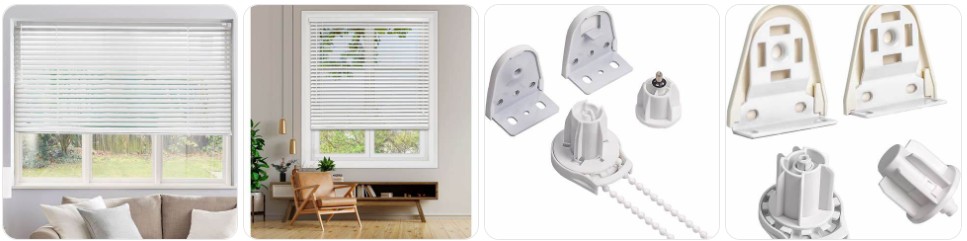
Venetian Blind replacement parts can usually solve common problems like slats that will not tilt, cords that fray or snap, broken ladder strings, damaged valance clips, and headrail hardware that no longer holds alignment. Instead of replacing the whole blind, it is often cheaper and faster to swap the failed component, especially on wood, faux wood, aluminium, and mini Venetian blinds where the slats are still in good shape.
Buy Venetian Blind Parts Online
A Venetian blind cord lock holds the lift cords in place so the blind stays at the chosen height. When it slips, jams, or stops gripping evenly, the blind drops unexpectedly or refuses to raise smoothly. » find on amazon / find on ebay
The wand tilter turns the tilt rod inside the headrail so the slats open and close evenly. A worn gear, cracked housing, or stripped hook usually causes stiff twisting, uneven tilting, or slats that no longer respond. » find on amazon / find on ebay
A Venetian blind tilt rod runs through the headrail and transfers motion from the tilter to each ladder drum. If it bends, strips, or disconnects, the slats may tilt only on one side or stop moving altogether. » find on amazon / find on ebay
Ladder string or ladder tape supports each slat and keeps spacing consistent from top to bottom. On Venetian blinds, fraying, twisting, or broken rungs make slats sag, overlap unevenly, or rub against each other during tilting. » find on amazon / find on ebay
Lift cords carry the weight of the bottom rail and stacked slats every time the blind is raised. When cords become fuzzy, stretched, or snap near the lock or tassel, height control becomes unreliable and unsafe. » find on amazon / find on ebay
Venetian blind brackets secure the headrail to the wall, frame, or recess and keep it level during use. Bent bracket doors, missing tabs, or loose screws often cause rattling, sagging, and a blind that feels unstable. » find on amazon / find on ebay
Valance clips hold the decorative front cover in place on wood and faux wood Venetian blinds. Once clips become brittle or crack, the valance falls forward, rubs the slats, or leaves the headrail looking unfinished. » find on amazon / find on ebay
A repair kit is useful when you are fixing several small failures at once, such as worn tassels, ladder cord issues, broken retainers, and hardware clips. It is the easiest all-in-one starting point for DIY Venetian blind maintenance. » find on amazon / find on ebay
Signs You Need Replacement Parts for Your Venetian Blind
- The slats tilt unevenly from one side to the other: If one side opens fully while the other side lags behind, the problem is usually a failing wand tilter, a bent tilt rod, or a disconnected ladder drum rather than the slats themselves.
- The blind will not stay raised at the chosen height: A slipping cord lock or worn lift cord often causes Venetian blinds to slide back down after you release them, especially on heavier faux wood or wood slatted models.
- Individual slats are hanging at odd angles: When the slats no longer sit level across the blind, check for torn ladder string, missing rungs, or stretched ladder tape because Venetian blinds depend on even support at every slat position.
- The wand twists but nothing happens: A stripped gear inside the tilter is one of the most common Venetian blind failures. If the wand turns freely without resistance, the internal mechanism usually needs replacing, not the full blind.
- The headrail rocks or rattles during operation: Loose or damaged mounting brackets let the headrail shift whenever the blind is raised or tilted. That extra movement can also accelerate wear on cords, tilt hardware, and the top slats.
- The valance keeps falling off the front: On wood and faux wood Venetian blinds, brittle valance clips are often the only failed part. Replacing them restores the finished look without changing the blind itself.
- The lift cords look fuzzy, thin, or discolored near the lock: That wear pattern usually means the cords are close to breaking. Do not wait for a full snap, because a sudden drop can damage slats and the bottom rail too.
- The bottom rail lifts crookedly: If one side rises faster than the other, the Venetian blind may have an uneven cord path, stretched ladders, or a frayed lift cord catching inside the headrail hardware.

AOOCEEPAW 17 Inches 2 Pieces Blind Wand, Vertical Replacement Parts, Tilt Replacement, Clear Rod with Hook and Grip, Plastic Opener, Long Window Stick Tilt Rod

2pcs Low Profile Wand Tilter Mechanism with 7/32" Hexagon Shaped Gear Hook Connection for Low Rail Horizontal Wood and Faux Wood Blinds headrail

Quadafy 2 Pack 17 inch Blind Wand, Vertical Blinds Replacement Parts | with Hook and Grip, White Fiberglass Blind Tilt Wand, for Windows Curtain Door Shades Opener Accessory
How to Identify the Right Venetian Blind Replacement Part
- Match the blind type before anything else: Check whether your Venetian blind is mini aluminium, standard aluminium, wood, or faux wood. Slat width, headrail shape, and hardware size vary a lot, so a part that fits a 1-inch mini blind may not fit a 2-inch faux wood blind.
- Measure the slat width and headrail precisely: Most Venetian repairs depend on the exact slat size and headrail profile. Measure the slat front-to-back width and the metal headrail dimensions before ordering a wand tilter, bracket, or valance clip.
- Compare the control style carefully: Some Venetian blinds use a twist wand, some use tilt cords, and others use mixed hardware. The replacement part has to match the original control system, otherwise the slats will not rotate correctly after installation.
- Inspect where the failure actually starts: If the blind drops, focus first on the cord lock and lift cord path. If the slats stop turning, look at the tilter, tilt rod, and ladder connection points. That prevents ordering the wrong hardware based only on symptoms.
- Count clips, ladders, and cord routes before buying: Venetian blinds rely on repeated hardware positions across the width. Count how many ladder strings support the slats and how the lift cords run through them so your replacement matches the blind’s original layout.
- Take one old part off and compare the shape: For brackets, retainers, and valance clips, the fastest method is usually to remove one intact sample and compare the slot design, tab position, and snap points with listings for Venetian blind repair kits or individual parts.
Should You Repair or Replace the Whole Venetian Blind?
Repairing a Venetian blind usually makes sense when the slats are still straight, the finish still looks good, and the failure is limited to one or two working parts such as the cord lock, wand tilter, lift cord, ladder string, or valance clips. These are common wear items, especially on blinds that are opened and tilted every day. Replacing a small part is often far cheaper than buying a full new blind, particularly with wider wood and faux wood Venetian blinds where replacement costs add up quickly.
You should consider replacing the whole Venetian blind when multiple slats are bent, the headrail is twisted, moisture has warped wood slats, or several systems have failed at the same time. If the blind has severe sun damage, badly mismatched slat color, or repeated cord wear from an old headrail design, a full replacement may be the more practical long-term solution. In borderline cases, compare the cost of a repair kit plus individual hardware against the price of a new Venetian blind.

HIDODO Aluminum Mini Blinds for Windows Cordless Horizontal Window Shades for Light Adjustment, Metal Venetian Blinds Waterproof for Bedroom, Bathroom, 36" W x 48" H, White

Calyx Interiors 1“ Mini Blinds, 33.5“W x 60“H, White, Light Filtering | Cordless Window Blinds for Indoor Windows, Vinyl Mini Blinds, Privacy Blinds for Home, Office, Kitchen & Bedroom Windows
How to Prevent Parts Damage to Venetian Blind
- Tilt the slats open before raising the blind: Lifting a Venetian blind while the slats are tightly closed puts extra strain on the lift cords, ladders, and bottom rail. Opening the slats first reduces friction and lowers stress on the headrail hardware.
- Use the wand gently instead of forcing resistance: If the wand feels stiff, stop and inspect the tilter or tilt rod before twisting harder. Forcing it can strip gears that might otherwise have needed only a small adjustment or cleaning.
- Raise and lower the blind evenly from the center: Pulling lift cords sharply to one side can wear the cord lock and cord path unevenly. Smooth, centered movement helps Venetian blinds stack straighter and reduces early fraying.
- Keep dust out of the headrail: Dust buildup inside the headrail can increase drag around moving parts. Light cleaning around the tilter, brackets, and cords helps the blind operate more freely and can extend the life of replacement hardware.
- Replace worn cords before they snap completely: Once lift cords become fuzzy, thin, or glazed from friction, fit a new lift cord early. Preventive replacement is easier than repairing a blind after a sudden drop damages several slats.
- Check bracket tightness on wide Venetian blinds: Wider blinds place more load on the headrail, especially in faux wood versions. Tight, correctly spaced brackets reduce headrail flex and help protect the tilter, ladders, and cord lock from avoidable strain.
Venetian Blind Parts FAQ
What is the most commonly replaced part on a Venetian blind?
The most commonly replaced Venetian blind parts are the cord lock, lift cord, wand tilter, ladder string, and valance clips. Which one fails first usually depends on whether the blind is raised often, tilted frequently, or exposed to heat and sunlight.
Can I replace just the tilt mechanism without replacing the whole blind?
Yes, in many cases you can replace only the tilter mechanism. If the slats, ladders, and headrail are otherwise in good condition, swapping the tilter is usually a straightforward and cost-effective fix for Venetian blinds with slats that no longer rotate properly.
How do I know if I need a new ladder string or a new lift cord?
If the slats sag, lean, or sit unevenly, the ladder string is often the issue. If the blind will not raise, stay up, or lowers crookedly, the lift cord or cord lock is more likely the failed part.
Are Venetian blind parts universal?
No, many Venetian blind parts are not universal. Slat width, headrail size, control style, and blind material all affect compatibility. It is best to measure carefully and compare the original part shape before ordering replacements online.
Is it worth buying a Venetian blind repair kit?
A repair kit is worth buying when your blind has several small issues at once or when you are not yet sure which minor hardware pieces need replacing. It is also useful for keeping common spare parts on hand for future maintenance.
Can bent Venetian blind slats be repaired with replacement parts?
Replacement parts can restore the operation of the blind, but badly bent or creased slats usually need to be swapped individually or the blind replaced if the damage is widespread. Hardware repairs will not fully correct visibly warped slats.

60 PCS Vertical Blind Repair Tabs Kit Clear Fixer Verticle Blinds Snap in Replacement Slats Parts Panels

joytrace RV Pleated Shade Repair Kit, RV Window Shade Restringing Kit, Repair and Maintain of Day Night Pleated Shade (White)
