
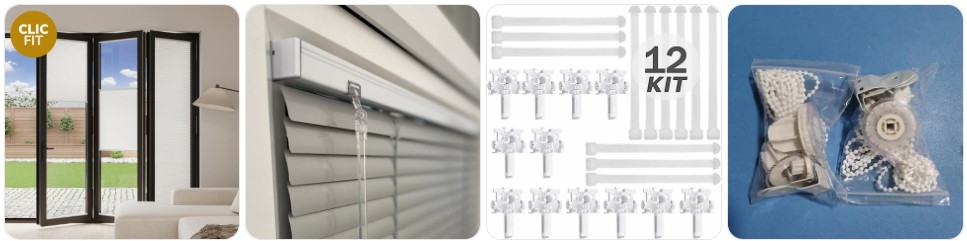
Clip-Fit Blinds are designed to attach neatly without traditional drilled brackets, so repairs usually focus on the clip-in fitting system, frame clips, side channels, tension pieces, small brackets, handles, and compact headrail hardware rather than heavy wall-mounted blind parts. The quick answer is that a broken Clip-Fit blind can often be repaired for much less than a full replacement if the blind fabric or slats are still in good condition and the problem is limited to one or two small fitting components. In many cases, the fix comes down to replacing a cracked clip, tightening a loose frame fitting, swapping a broken handle, refitting a side guide, or correcting a tension issue before the blind starts sitting crooked or pulling away from the frame. If you want to compare useful products while troubleshooting, it helps to browse Clip-Fit blind repair kits, Perfect Fit blind parts, and no-drill blind clips.
Fix Common Clip-Fit Blind Problems & Repair Cost
The Clip-Fit blind no longer sits securely against the window frame: This is one of the most common Clip-Fit blind problems and usually points to a worn clip, cracked fitting tab, loose frame bracket, or a support piece that has stopped gripping the window bead properly. Because Clip-Fit blinds rely on precise pressure and alignment rather than conventional screw-fixed mounting, even a small clip failure can make the whole blind feel unstable. In many cases, the repair involves replacing the damaged clip or re-seating the fitting system rather than replacing the whole blind. Minor repairs are often in the range of about $5 to $20 in parts, while a broader repair involving several fittings, guides, or brackets can run around $15 to $40 depending on the blind size and mounting style. It helps to compare Clip-Fit blind repair kits and no-drill blind clips. Do not keep forcing a loose Clip-Fit blind back into place, because that can damage the frame fittings and the blind body at the same time.
The blind has started hanging crooked or uneven inside the frame: On a Clip-Fit blind, uneven hanging often means one clip has shifted, one side guide is loose, the frame fit is out of square, or the blind is no longer being supported evenly on both sides. Because this style is meant to sit close and tidy against the glass, even a small alignment problem becomes very noticeable. Depending on the cause, the repair may be as simple as tightening, re-clipping, or replacing one damaged fitting. If the blind body itself has also shifted or twisted, the repair may involve both the blind hardware and the fitted frame pieces.
The handle, pull tab, or operating piece is broken: If the blind still fits correctly but is difficult to raise, lower, or position, the problem may be limited to a small handle or control part rather than the full blind system. Clip-Fit blinds often use compact operating pieces designed for neat in-frame use, so these parts can wear or crack with repeated handling. Replacing the handle or operating accessory is often one of the simplest repairs, and the part itself is usually inexpensive. Search terms such as blind handle replacements and Perfect Fit blind parts can help if the rest of the blind still works properly.
The side channels or guide pieces no longer sit flush: This is common on Clip-Fit blinds that rely on neat side guidance to stay close to the frame. If a guide strip has loosened, warped, or shifted, the blind may stop moving smoothly and can start looking untidy around the edges. If the guide and blind are still straight, refitting the guide or replacing a clip or small support piece is often worth doing.
The blind moves, but the fit feels loose or rattly: Clip-Fit blinds depend on a snug, stable fit, so rattling or movement usually means the blind is no longer being held firmly by the original clips or frame fittings. Replacing or tightening those parts can often restore the neat integrated look that this style is meant to have.
Clip-Fit Blind Repair Kit
A Clip-Fit blind repair kit is most useful when the problem is in the fitting system, side guides, handles, or no-drill mounting hardware rather than in the main blind body itself. Because Clip-Fit blinds are built around a frame-mounted or pressure-mounted setup, the parts that fail are usually small but important for keeping the blind aligned, stable, and easy to use. A good Clip-Fit blind repair kit may include replacement clips, guide pieces, small brackets, handles, tension parts, fitting tabs, screws, or other small components that help restore the blind without replacing the whole unit.
It is worth checking the kit contents carefully because some products are sold under broader terms such as no-drill blind parts or Perfect Fit accessories even when they are suitable for Clip-Fit blinds. If the problem is limited to one obvious issue, such as a cracked clip or loose guide piece, buying that single part may be the cheaper option. But if the blind is already sitting unevenly, rattling in the frame, and showing wear around several fittings, a broader Clip-Fit blind repair kit or a set of Perfect Fit blind parts can make the repair much more consistent. For Clip-Fit blinds, keeping the blind square inside the frame matters just as much as replacing the damaged part itself.

Blulu 30 Pcs Vertical Blind Repair Vane Savers, Metal Blind Repair Tabs | Vertical Blind Repair Tabs, Vertical Blinds Repair Clips Kit, Fits Blinds Replacement Slats & Parts

60 PCS Vertical Blind Repair Tabs Kit Clear Fixer Verticle Blinds Snap in Replacement Slats Parts Panels

Vertical Blind Repair Vane Savers, 12PCS Metal Vertical Blind Repair Tabs, Vertical Blinds Repair Kit for Vertical Blinds Replacement Slats
Signs Your Clip-Fit Blind Need Repair
- The blind no longer sits tightly against the frame: This usually points to a worn clip, loose bracket, or shifted fitting piece. Checking no-drill blind clips is often a smart first step.
- One side of the blind hangs lower than the other: On a Clip-Fit blind, this usually means one fitting point has moved or one guide is no longer supporting the blind evenly.
- The blind rattles or moves when the window is opened: If the blind is fitted to a door or opening window, extra movement often means the clip system is wearing out or no longer gripping correctly.
- The guide pieces or side strips are coming loose: If the guidance system is shifting, compare Perfect Fit blind parts before assuming the full blind needs replacing.
- The handle or pull piece has broken: Clip-Fit blinds often use compact operating accessories, and these can crack with frequent use even when the rest of the blind is still in good condition.
- The blind still looks good, but the fitting system feels unreliable: This is often the best time to repair a Clip-Fit blind, because the issue is still mainly mechanical rather than cosmetic.
- The blind has started rubbing the frame or moving roughly: Sometimes the visible issue is not the blind fabric or slats, but a guide, clip, or mounting point that has shifted out of place.
- The blind no longer looks neat and integrated: Clip-Fit systems are chosen for their tidy finish, so visible gaps, movement, or uneven alignment are strong signs that repair is needed.
Tools You May Need to Repair Clip-Fit Blind
- Measuring tape: A measuring tape helps you check blind width, frame depth, clip spacing, and replacement part sizes before ordering anything.
- Needle-nose pliers: A pair of needle-nose pliers helps with tight clips, small guide fittings, and compact blind hardware without damaging them.
- Replacement frame clips: If the blind feels loose or will not sit securely, matching no-drill blind clips is often one of the most useful repair items to have on hand.
- Guide pieces or support strips: Worn or loose guides are a common cause of poor alignment. Comparing Perfect Fit blind parts is useful if the blind no longer runs neatly inside the frame.
- Small screwdriver set: A precision screwdriver set is useful if a bracket, guide, or small operating part has to be adjusted or replaced.
- Replacement handle or pull tab: If the blind is awkward to move because the original operating piece broke, a matching blind handle replacement may be the part you need.
- Clean work surface and soft cloth: Clip-Fit blinds often need to be removed or supported during repair, so it helps to protect the blind while you inspect the frame fittings and guide pieces.
- Small spirit level: A small spirit level can help you check whether the blind is sitting square in the frame before you refit it.
Should You Repair or Replace Your Broken Clip-Fit Blind?
Repairing a broken Clip-Fit blind usually makes sense when the blind body still looks good and the problem is clearly limited to the fitting clips, side guides, handle, or one small support part. Because Clip-Fit blinds are often chosen for doors, tilt-and-turn windows, and neat modern window frames, it is often worth fixing a blind that still looks good but has one mechanical fitting issue. In that situation, replacing the failed hardware is usually much cheaper than replacing the whole blind, especially if all you need is a Clip-Fit blind repair kit, a new clip, or a replacement guide piece.
Replacement becomes the better option when the blind body is damaged, the frame-mounted fitting system has worn out in several places at once, or the blind no longer sits square even after the main hardware has been repaired. It may also make sense to replace the whole blind if the original fittings are too specific to match easily or the blind was a very low-cost ready-made model to begin with. A quick comparison between Clip-Fit blind options and the parts you need can help you decide. In many cases, though, Clip-Fit blinds are worth repairing when the problem is in the fitting system rather than the visible blind itself.
20 PCS Hidden Channel Valance Clips, 1-7/8 Inch Blind Clips for Valance with a Groove in The Back

Leinuosen 12 Pieces Vertical Blind Clips Stems Replacement Parts | Vertical Blind Carrier Stems, 8 mm Head, Replacement Parts for 3-1/2 or 5 Inch Vertical Blind Vanes, Headrail Accessories

10 PCS 1-7/8 Inches Plastic Valance Clips - Replacement Clips for Window Blinds, Fits Wooden Valances
Tips to Make Your Clip-Fit Blind Last Longer
- Use the blind gently and evenly: Sudden pulling or twisting puts more strain on the clip system and guide pieces than controlled movement.
- Do not keep using the blind if it starts sitting crooked: Continuing to operate a misaligned Clip-Fit blind can wear out the clips and support fittings much faster.
- Check the frame clips and guides occasionally: Clip-Fit blinds rely on tight alignment for a neat appearance, so small shifts can quickly turn into bigger fitting problems.
- Keep the frame area clean: Dust and dirt around the guides or fitting points can make the blind feel rough and reduce how securely the system sits against the frame.
- Support the blind during cleaning: Clip-Fit blinds look simple, but the no-drill fittings and compact guides can be stressed if the blind is handled roughly during maintenance or removal.
- Do not ignore a loose clip: Replacing a worn clip early is much easier than dealing with a blind that has started dropping or rubbing because the whole fitting system has shifted.
- Store removed Clip-Fit blinds flat and protected: If the blind has to come down for repair, protect both the blind body and the clip hardware so it can be refitted without new damage.
- Replace small worn parts early: A fresh clip, guide, or handle is much cheaper than rebuilding a badly worn Clip-Fit system later.
Clip-Fit Blind Repairs FAQ
What usually breaks on a Clip-Fit blind?
The parts that fail most often are clips, guide pieces, handles, small brackets, support tabs, and other compact frame-mounted components. On Clip-Fit blinds, the fitting system usually wears out before the blind body does.
Can I fix a Clip-Fit blind that hangs unevenly?
Yes, in many cases. The most common causes are a shifted clip, loose guide, worn support piece, or a blind that is no longer sitting square in the frame. Correcting those parts is often enough to solve the problem.
Is a Clip-Fit blind repair kit worth buying?
It can be, especially when the blind has more than one small fitting issue. A Clip-Fit blind repair kit is often easier than sourcing clips, guide pieces, and handles separately.
Why is my Clip-Fit blind no longer sitting tightly against the frame?
This usually means one or more of the clips, guides, or small fitting supports are no longer holding the blind securely. Because Clip-Fit blinds are designed to sit neatly against the frame, even small fitting problems show up quickly.
Can I replace just the clips or guides on a Clip-Fit blind?
Yes, if those are the only clearly worn parts and the rest of the blind still works properly. Replacing them early can also prevent extra strain on the remaining fittings.
How much does it usually cost to repair a Clip-Fit blind?
Minor repairs such as a clip, guide, handle, or small fitting are often relatively inexpensive, usually around $5 to $20 in parts. Larger repairs involving several hardware pieces may cost more, but they are still often cheaper than replacing the full blind.
Should I repair or replace a Clip-Fit blind with repeated fitting problems?
If the blind body is still in good condition and the issue is clearly coming from the fitting hardware, repair still makes sense. If the blind keeps sitting badly even after hardware fixes or the main blind body is also damaged, replacement may be the better long-term option.
Can Clip-Fit blind parts be hard to match?
Sometimes, yes. Clip shapes, guide profiles, fitting styles, and support tabs can vary by brand and blind design, so it helps to compare measurements and product photos before ordering replacement parts.
60 PCS Vertical Blind Repair Tabs Kit Clear Fixer Verticle Blinds Snap in Replacement Slats Parts Panels

joytrace RV Pleated Shade Repair Kit, RV Window Shade Restringing Kit, Repair and Maintain of Day Night Pleated Shade (White)
