
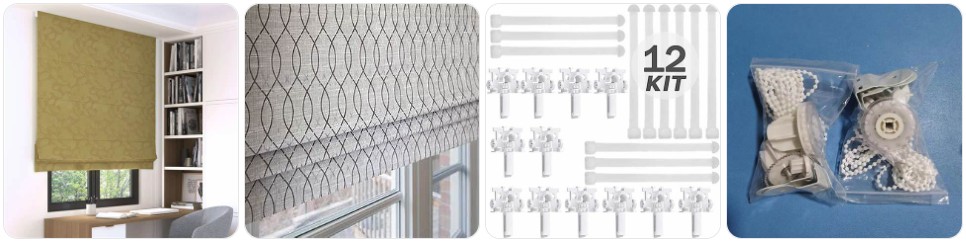
Roman Blind replacement parts for a flat Roman blind usually include the cord lock or clutch, lift cord, rear support rods, bottom bar, rings, brackets, chain or cord connectors, and mounting hardware. Because a flat Roman blind is designed to keep a smooth front face while stacking into clean folds, even one worn internal part can make the blind hang crooked, bunch unevenly, or refuse to raise smoothly. This guide explains which parts commonly fail, how to identify the right replacement, when a repair is worth doing, and where to buy components online.
Buy Flat Roman Blind Parts Online
A cord lock holds the lift cords in place so the blind stays at the height you choose. When it slips, sticks, or stops gripping, the flat Roman shade can drift down or raise unevenly. » find on amazon / find on ebay
Lift cord carries the load of the fabric panel and helps the blind stack into neat folds. Frayed or stretched cord often causes one side of a flat Roman blind to sit lower than the other. » find on amazon / find on ebay
Sew-on rings guide the cords vertically up the back of the blind. Missing or cracked rings can pull the folds off line, especially on a flat Roman blind where the front should stay smooth and centered. » find on amazon / find on ebay
Rear support rods help the blind fold evenly without creating bulky front loops. Bent, missing, or undersized rods are a common reason a flat Roman blind loses its crisp horizontal lines when raised. » find on amazon / find on ebay
The bottom bar keeps the lower edge straight so the blind hangs flat when fully lowered. If it warps or slips out of its pocket, the blind may tilt, curl, or develop a soft sag along the hem. » find on amazon / find on ebay
Headrail hardware includes internal pulleys, spools, drums, and carrier pieces that route the cords across the top. Damage here often shows up as jerky lifting, rubbing noises, or folds that stack tighter on one side. » find on amazon / find on ebay
Brackets secure the headrail to the wall, frame, or recess. A bent or loose bracket can throw the whole blind out of level, which is especially noticeable on flat Roman blinds with patterned or striped fabric fronts. » find on amazon / find on ebay
Some modern flat Roman blinds use chain-operated clutch systems instead of traditional cord locks. If the chain skips, breaks, or jams, the blind can stop partway or roll unevenly through the lift mechanism. » find on amazon / find on ebay
A repair kit usually bundles lift cord, rings, cord guides, toggles, and small installation hardware for common fixes. It is a practical first purchase when you have multiple worn parts but do not need a full blind replacement. » find on amazon / find on ebay
Signs You Need Replacement Parts for Your Flat Roman Blind
- The front panel no longer hangs perfectly flat: A true flat Roman blind should present a smooth fabric face when lowered. If the front starts bowing or pulling to one side, check the support rods, bottom bar, and rear ring alignment before blaming the fabric.
- The folds stack unevenly when raised: Flat Roman blinds are supposed to form tidy, balanced folds. If one fold is bulky while another disappears, a stretched lift cord, missing ring, or damaged headrail guide is usually the cause.
- One side rises faster than the other: This is one of the clearest signs that a lift cord has frayed, slipped, or changed tension. On a flat Roman blind, even small differences show up quickly because the style relies on clean horizontal stacking.
- The blind slowly drops after you let go: A slipping cord lock or worn clutch means the shade cannot hold position. Replacing the faulty mechanism is often much cheaper than replacing a well-made fabric blind.
- The bottom hem looks tilted when the blind is down: A bent bottom bar or loose hem weight can make the entire blind look custom-made badly, even when the fabric is still fine. Flat Roman blinds need a straight lower edge to look finished.
- You hear rubbing or clicking inside the headrail: Noise during lifting often points to worn pulleys, cord guides, or a rough clutch path. That kind of friction can damage fresh cord if you ignore it too long.
- The fabric pattern no longer sits square to the window: Because flat Roman blinds are often chosen to showcase prints and stripes, any off-center lifting stands out immediately. In many cases, the issue is hardware-related, not decorative-fabric related.
- The blind works, but feels stiff or jerky: Resistance usually means the cords are dragging through misaligned rings or the headrail parts are starting to fail. A repair kit can be a cost-effective first fix if several small parts are worn at once.

AHANDMAKER 4 Set Cord Lock Mechanism, 3 Line Idler Pulley Swivel Type Blinds Lock Replacement Brackets Roman Shade Hardware Kit for Roman Woven Wood Shades and Bamboo Window Covering

Luanxu Universal Roller Shade Clutch for 1 1/2" (38mm) Tube with Metal Bracket & Bead Chain, Roller Blind Replacement Spare Repair Parts, Metal Core, Long Service Life, Heavy Duty, Max Load 8KG

6 Pieces White Roman Shade Cord Lock Dual Brass Wheels Stainless Bracket
How to Identify the Right Flat Roman Blind Replacement Part
- Start with the lift style first: Check whether your flat Roman blind uses a traditional cord lock or a chain-driven clutch. If you order the wrong operating style, the replacement part may fit the headrail poorly or not work with your current lift path at all.
- Measure the rod pockets before buying support inserts: Flat Roman blinds usually rely on rear rods to create crisp folds while keeping the front face smooth. Measure the pocket width and rod diameter carefully before ordering replacement rods.
- Count the rows of rings from bottom to top: The number and spacing of ring rows affect how the blind lifts and stacks. Replacing only one damaged ring with the wrong size or position can make a flat Roman blind pull out of square.
- Check whether the bottom bar is removable or sewn into a pocket: Some flat Roman blinds let you slide the bar out easily, while others need partial stitching opened. That matters because a new weight bar must match both the length and the style of hem pocket.
- Inspect the headrail width and bracket shape together: Brackets are not interchangeable just because they look similar. Measure the headrail depth, face width, and mounting style so the replacement bracket keeps the blind level instead of twisting the rail.
- Match cord diameter rather than guessing by appearance: Roman shade cord that is too thick can bind in the lock or guides, while cord that is too thin may slip. When replacing lift line, compare the old diameter closely or buy a compatible Roman shade lift cord.
- Look for wear on the back, not just the front: Flat Roman blinds often look fine from the room side even when the rear hardware is failing. Turn the blind around and inspect ring stitching, cord routes, rod pockets, and top hardware before ordering parts.
- Use a repair kit when several small items are aging together: If the blind has brittle rings, tired cord, and worn guides, buying a single repair kit can be more practical than sourcing every piece individually, especially on older flat Roman blind systems.
Should You Repair or Replace the Whole Flat Roman Blind?
In many cases, a flat Roman blind is worth repairing when the fabric face is still attractive and the problem is limited to the operating system. This style is often chosen because it shows off patterned, striped, or textured fabric in a clean flat panel, so replacing a cord lock, new sew-on rings, a bottom bar, or fresh lift cord is usually far cheaper than remaking the entire blind. If the shade is custom-sized, repair is even more appealing because the existing fabric and lining may be difficult to match exactly.
You should lean toward a full replacement when the fabric has shrunk, the lining is separating, several rod pockets are torn, and the headrail hardware is obsolete or badly damaged at the same time. Flat Roman blinds depend on both good structure and clean alignment; once the fabric body and the lift system have both failed, the repair cost can start approaching the price of a new flat Roman blind. As a rule, repair isolated hardware problems, but replace the whole blind when the fabric, fold geometry, and mechanism have all degraded together.

Changshade No Drill Roman Shades Cordless Blinds Blackout for Indoor Windows, Room Darkening Black Out Tension Rod No Hardware No Tools Inside Mount, Shade Size 34 Inches Wide 64 Inches High, Beige

LazBlinds Cordless Bamboo Roman Shades, 34.5x48, Highfield Teak | Privacy Blinds for Interior Windows, Room Darkening Roll Up Bamboo Blinds for Home & Patio

Boolegon Blackout Roman Shades for Indoor Windows, Linen White, Custom Size | Cordless Roman Blinds for Windows, Thermal Insulated Window Shades for Door, Bedroom, Office, Easy to Install
How to Prevent Parts Damage to Flat Roman Blind
- Raise and lower the blind evenly every time: Flat Roman blinds depend on balanced cord tension to keep the front panel smooth. Pulling too sharply from one side puts extra strain on rings, guides, and the lower edge, which can distort the folding pattern over time.
- Do not let the folds slam upward into the headrail: Fast lifting can compress the stacked folds and stress the top hardware. A controlled movement helps protect the cord lock, clutch, and internal guides that shape how the flat Roman blind stacks.
- Keep the rear cords and rings free from dust buildup: Dust and lint can increase friction where the cords pass through the rings. A quick occasional check on the back of the blind helps reduce drag and extends the life of the lift system.
- Support the fabric when removing the blind for cleaning: Never carry a flat Roman blind by one bracket or by the front fabric alone. Support the headrail and the fabric body together so the rods, ring rows, and bottom bar do not shift out of alignment.
- Avoid overloading the blind with heavy replacement lining or trim: Flat Roman blinds are tuned to a certain fabric weight. Adding thicker blackout lining or decorative trim without adjusting the mechanism can overwork the cords and headrail parts.
- Check rod position after washing or steaming nearby fabrics: Moisture and handling can sometimes nudge support rods or soften stitching on older shades. Make sure the rods remain fully seated in their pockets so the blind keeps its crisp fold spacing.
- Replace frayed cord early instead of waiting for a break: Once a lift cord starts fuzzing, it can cut into guides and jam inside the lock. Swapping it for fresh replacement cord early is much easier than rebuilding the whole routing path later.
- Keep a small repair kit on hand for older shades: For frequently used flat Roman blinds, spare rings, cord, and a few compatible hardware pieces make quick fixes easier before a minor alignment problem turns into a major operating failure.
Flat Roman Blind Parts FAQ
What replacement parts fail most often on a flat Roman blind?
The most common failures are usually the lift cord, sew-on rings, cord lock or clutch, support rods, and bottom bar hardware. On a flat Roman blind, these parts matter more than usual because the style depends on a smooth front panel and evenly stacked folds.
Can I repair a flat Roman blind if only one side is sagging?
Yes, in many cases you can. One-sided sagging is often caused by stretched cord, a broken ring, or a slipping lock rather than ruined fabric. Check the rear cord path and compare the ring rows before replacing the whole blind.
Are flat Roman blind parts the same as standard Roman blind parts?
Many are similar, but not always identical in how they are configured. Flat Roman blinds often rely heavily on rear support rods and careful ring spacing to preserve the flat front appearance, so generic Roman parts may need closer measurement before purchase.
Do I need a repair kit or individual parts?
If only one component has failed, buying a single part is usually enough. If the blind has brittle rings, worn cord, and minor headrail wear together, a Roman shade repair kit is often the more practical and economical option.
How do I know whether my flat Roman blind uses rods or just weight bars?
Turn the blind over and inspect the back. If you see several horizontal pockets running across the width, those usually hold support rods. A single pocket at the bottom normally holds the weight bar or bottom bar.
Can I replace the lift cord without removing the fabric panel?
Sometimes, but not always. If the cord path is accessible through the rings and headrail, you may be able to rethread it with limited disassembly. If the blind has stitched sections or hidden routing, partial removal is often the cleaner approach.
Why does my flat Roman blind still look crooked after replacing the cord?
If new cord does not solve the issue, check for a bent bottom bar, shifted support rod, uneven ring spacing, or a headrail that is no longer level in its brackets. Flat Roman blinds reveal alignment problems quickly because the front should hang clean and straight.
Where can I buy flat Roman blind replacement parts online?
You can usually find them through Roman shade and blind hardware listings, including Flat Roman blind parts on Amazon and matching search listings on eBay for cords, locks, rings, rods, brackets, and repair kits.

60 PCS Vertical Blind Repair Tabs Kit Clear Fixer Verticle Blinds Snap in Replacement Slats Parts Panels

joytrace RV Pleated Shade Repair Kit, RV Window Shade Restringing Kit, Repair and Maintain of Day Night Pleated Shade (White)
