
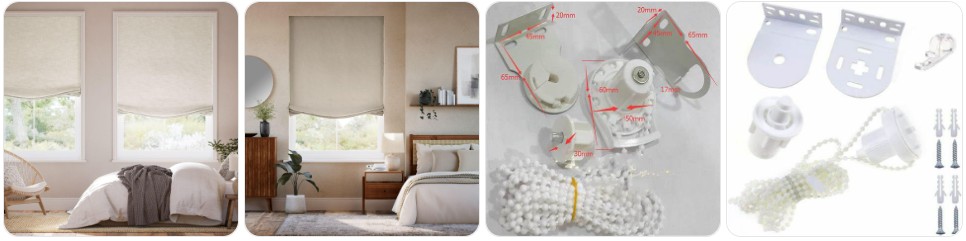
If you are trying to fix a soft-fabric Roman shade with a curved bottom edge, Relaxed Roman Blinds usually need a few very specific parts rather than a full replacement. The most common issues are broken lift cords, missing rings, worn cord locks, bent brackets, or a sagging lower profile caused by uneven support. This guide covers the most useful Relaxed Roman Blind replacement parts, how to identify the right one, and when a simple repair is better than replacing the whole blind.
Buy Relaxed Roman Blind Parts Online
Lift cord is the part that actually raises and lowers the blind through the ring lines and headrail. On a Relaxed Roman style, frayed or stretched cord often causes the curved hem to lift unevenly and spoil the soft drape. » find on amazon / find on ebay
Small sewn rings guide the lift cords vertically up the fabric panel. When one breaks or pulls loose, a Relaxed Roman Blind may develop a twisted fold pattern or a lopsided bottom curve instead of hanging in a smooth scallop. » find on amazon / find on ebay
The cord lock sits in the headrail and holds the blind at the chosen height. If it slips, jams, or stops gripping evenly, the blind can drift downward and the relaxed lower edge may lose its intended centered droop. » find on amazon / find on ebay
Pulleys redirect multiple lift cords across the rail so the fabric rises in sequence. On Relaxed Roman designs, worn pulleys create drag and uneven tension, which can pull one side tighter than the other and distort the soft bottom arc. » find on amazon / find on ebay
Support rods help the fabric fold cleanly as the blind stacks upward. In a Relaxed Roman Blind, the rods need to support pleating without flattening the decorative droop, so bent or missing battens often cause a messy, bunching appearance. » find on amazon / find on ebay
Mounting brackets hold the headrail square to the wall or recess, which matters a lot on Relaxed Roman styles because any tilt makes the center droop look off-balance. Replacing loose or bent brackets can restore the blind’s soft symmetrical profile. » find on amazon / find on ebay
A light bottom bar or sewn weight helps the blind keep its graceful center dip instead of fluttering or bowing awkwardly. When this piece bends, shifts, or goes missing, the relaxed hem can lose the signature soft crescent shape. » find on amazon / find on ebay
A repair kit is the easiest option when you need several small items at once, such as cord, rings, screws, and replacement hardware. It is especially useful for older Relaxed Roman Blinds with multiple worn parts throughout the lift system. » find on amazon / find on ebay
Signs You Need Replacement Parts for Your Relaxed Roman Blind
- The bottom curve no longer hangs evenly: A Relaxed Roman Blind should have a soft central dip rather than a flat or crooked lower edge. If one side lifts higher, inspect the lift cord, rings, and pulleys for uneven tension or hidden wear.
- The blind stacks into messy folds instead of soft pleats: When the fabric bunches awkwardly as it rises, the support rods or battens may be bent, missing, or sliding in their channels. This is especially noticeable on Relaxed Roman styles because the shape relies on controlled softness, not stiff flat folds.
- The center droop has disappeared: If the blind looks flat across the bottom instead of gently scalloped, the weight bar may have shifted, the lower seam may be unsupported, or the blind may be lifting too tightly on one cord line.
- One side climbs faster than the other: A Relaxed Roman Blind that twists during lifting usually has one damaged guide ring, pulley, or cord run. Because the style is meant to look balanced even when partly raised, uneven movement is a strong sign a replacement part is overdue.
- The blind slips down after you raise it: If it will not stay set at the chosen height, the cord lock inside the headrail is often worn out. On a soft relaxed profile, this can quickly make the blind look saggy and spoil the intended draped finish.
- You hear scraping or feel resistance when pulling the cords: A gritty or jerky action often points to worn pulleys, tangled cord routing, or headrail friction. Replacing those internal parts is usually more effective than forcing the blind, which can tear fabric rings loose.
- The headrail looks level but the fabric hangs off-center: This often means the issue is not the installation but a hidden internal part such as a stretched cord, displaced bottom weight, or misaligned ring spacing sewn into the back of the blind.
- Bracket movement changes the shape of the hem: If touching the blind or opening a nearby window makes the lower scallop shift visibly, check the mounting brackets. A slightly loose bracket can distort the whole presentation of a Relaxed Roman Blind.

6 Pieces White Roman Shade Cord Lock Dual Brass Wheels Stainless Bracket

20pcs White Plastic Cord Tassel Window Blind Cord Knobs Drops Pull End for Roman Shades Curtain Crafts Drawstring Tassels

AHANDMAKER 4 Set Cord Lock Mechanism, 3 Line Idler Pulley Swivel Type Blinds Lock Replacement Brackets Roman Shade Hardware Kit for Roman Woven Wood Shades and Bamboo Window Covering
How to Identify the Right Relaxed Roman Blind Replacement Part
- Start with how the lower edge fails: If the blind loses its signature curved bottom, check the bottom bar, weight placement, and outer cord tension first. A Relaxed Roman Blind depends on that shaped hem, so the problem is often in the support or lift balance rather than the front fabric.
- Trace the cord path from hem to headrail: Look at each sewn ring and follow every lift cord upward to the headrail. If one line is more frayed, tighter, or slower than the others, match your replacement to that exact run before buying a repair kit or individual parts.
- Check whether your blind uses stitched rings or tape-mounted guides: Some Relaxed Roman Blinds use traditional sewn rings on the back of the fabric, while others use tape systems. Buying the wrong guide style can change the fold spacing and affect the soft drape.
- Measure the rod or batten pockets carefully: Relaxed Roman models still need internal structure, but the battens must fit the sewn channels correctly. Measure pocket width and length before ordering replacement support rods so you do not create bulky folds or fabric distortion.
- Confirm the bracket style before replacing the headrail hardware: Face-fix, top-fix, and recess brackets can all appear similar at a glance. On a Relaxed Roman Blind, even a slight mounting mismatch can tilt the rail and make the center droop look visually wrong.
- Inspect the number of lift lines, not just the blind width: Wider Relaxed Roman Blinds may use more cord routes than narrower ones, and each route affects the final drape. Count every line and guide position before ordering pulleys, rings, or replacement cord lengths.
- Match repair parts to the operating style: If your blind is cord-operated, focus on cord locks, pulleys, and rings. If it uses a chain-driven cassette or updated Roman track, search for the correct Roman blind control hardware by mechanism type, not by fabric style alone.
- Photograph the back and underside before removing anything: Relaxed Roman Blinds can look simple from the room side, but the rear layout determines the part fit. A quick photo of ring spacing, bracket shape, and headrail routing makes it much easier to buy the exact replacement rather than a generic guess.
Should You Repair or Replace the Whole Relaxed Roman Blind?
In many cases, a Relaxed Roman Blind is worth repairing because the visible fabric is often still in good condition while the problem is hidden in the lift system. If the blind still matches your room, the fabric is not sun-brittle, and the soft lower curve can be restored with new rings, lift cord, or a replacement cord lock, repairing is usually the more practical option. This is especially true when the issue is isolated to one side lifting unevenly or the blind slipping down after use.
You should think about full replacement when the fabric has stretched out of shape, several rod channels have failed, the stitching around multiple rings is tearing, or the decorative lower profile no longer returns even after hardware repair. A Relaxed Roman Blind relies more on balanced drape than a flatter Roman style, so once the fabric structure itself is badly distorted, a new blind may look better than repeated hardware fixes. If you are comparing that option, browsing Relaxed Roman Blind listings can help you judge whether a repair or replacement makes more sense for your budget.

Neutral Curtains Lily Cordless Relaxed Roman Window Shades, Custom Linen Blackout Roman Shades for Windows, Room Darkening Roman Blinds for Bedroom, 1 Shade, Relaxed

Everyday Celebration Linen Relaxed Cordless Roman Shades, 26"x64" White | Dual-Layer with Lining, Linen Blend, Light Filtering, Fits Windows, French Doors

Everyday Celebration Linen Relaxed Cordless Roman Shades, 29"x64" Natural | Dual-Layer with Lining, Linen Blend, Light Filtering, Fits Windows, French Doors
How to Prevent Parts Damage to Relaxed Roman Blind
- Raise the blind evenly every time: A Relaxed Roman Blind should be lifted with smooth, steady tension so the center dip stays balanced. Jerking one side or pulling too fast increases stress on the rings, cord paths, and lower hem shaping.
- Keep the folds dressed after lowering: Once the blind is down, gently shape the fabric so the lower edge settles into its natural soft curve. This reduces long-term creasing in the wrong places and helps the support rods and weights stay aligned.
- Do not leave the blind half-caught on window handles: Because Relaxed Roman styles have a looser lower profile, the fabric can snag more easily than a flatter Roman design. Repeated snagging can shift the bottom weight and strain the outer lift lines.
- Clean dust from the back hardware, not just the front fabric: The rear rings, cord paths, and headrail pulleys collect dust over time. Light maintenance helps cords slide more freely and reduces the friction that often causes uneven lifting or premature wear.
- Re-secure loose brackets early: A bracket that moves only slightly can still throw off the visual symmetry of a Relaxed Roman Blind. Tightening or replacing mounting brackets early is much easier than correcting a badly distorted hanging line later.
- Avoid over-tightening replacement cords: New cords should restore smooth operation, not pull the blind into a rigid shape. On Relaxed Roman styles, excessive tension can flatten the lower drape and put extra stress on rings and pulleys.
- Check the bottom weight after washing or fabric handling: If the blind has been cleaned, rehung, or adjusted, make sure the weight bar still sits centered. A shifted weight changes how the relaxed hem falls and can make owners misdiagnose the problem as a failed cord system.
- Keep a small spare-parts set on hand: Having extra cord, rings, and a basic Roman blind repair kit nearby makes it easier to fix minor wear before it spreads into a larger lift-system failure.
Relaxed Roman Blind Parts FAQ
What replacement parts fail most often on a Relaxed Roman Blind?
The most common failures are lift cords, sewn rings, cord locks, pulleys, and bottom support or weight components. On a Relaxed Roman Blind, even a small failure in one of these parts can make the soft lower curve hang unevenly or flatten out completely.
Is a Relaxed Roman Blind different from a standard Roman Blind when buying parts?
Many internal parts are shared with standard Roman blinds, especially cords, rings, pulleys, and brackets. The difference is that a Relaxed Roman Blind depends more on balanced tension and correct lower-edge support, so the fit and placement of those parts matter more for the final shape.
Can I use a generic Roman blind repair kit on a Relaxed Roman Blind?
Usually yes, as long as the kit includes the right size cord and compatible rings or hardware for your blind. A good starting point is a Roman blind repair kit, but it still helps to compare your existing ring spacing, cord count, and bracket style before ordering.
Why does my Relaxed Roman Blind look crooked even though the brackets are level?
If the brackets are level, the problem is often hidden in the blind itself. Uneven cord tension, a broken sewn ring, a shifted bottom weight, or a bent support rod can all make the center droop sit off to one side.
Do I need to replace the whole blind if the bottom curve has disappeared?
Not always. If the fabric is still sound, replacing the weight bar, support elements, or worn lift components may restore the relaxed shape. Full replacement is more likely when the fabric has stretched badly, several channels have failed, or the rear stitching is breaking across multiple points.
What is the easiest part to check first on a Relaxed Roman Blind that will not stay up?
The first part to inspect is usually the cord lock in the headrail. When it wears out, the blind may slide downward on its own, which is especially noticeable on a soft-fabric Relaxed Roman style with a weighted lower edge.
Where can I buy Relaxed Roman Blind replacement parts online?
You can usually find the most common items by searching for Roman blind hardware rather than only the relaxed style name. Useful starting points include Amazon searches for Relaxed Roman Blind parts and matching eBay listings for cords, rings, locks, brackets, and repair kits.

60 PCS Vertical Blind Repair Tabs Kit Clear Fixer Verticle Blinds Snap in Replacement Slats Parts Panels

joytrace RV Pleated Shade Repair Kit, RV Window Shade Restringing Kit, Repair and Maintain of Day Night Pleated Shade (White)
