
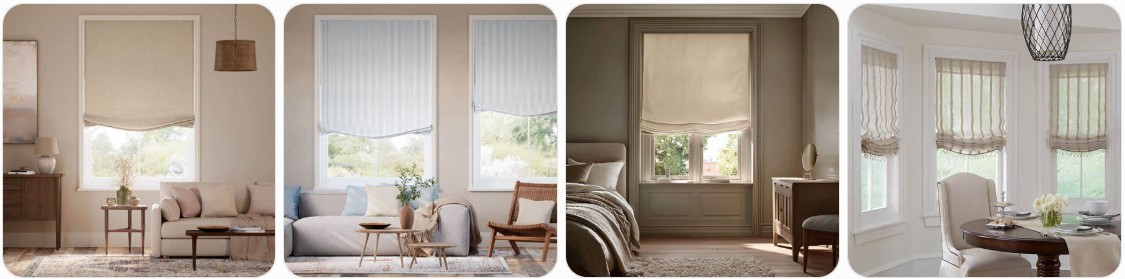
Relaxed Roman blinds are a soft, decorative window treatment that gives a room a casual but elegant fabric finish. Instead of folding into a perfectly straight bottom edge, relaxed Roman blinds create a gentle curved dip when lowered, making them especially popular for bedrooms, living rooms, dining spaces, cottages, and traditional interiors. This guide explains how they work, where to buy them, what they cost, the pros and cons, and what to check before ordering.
- Table of Contents:
- Relaxed Roman Blinds At a Glance
- What Are Relaxed Roman Blinds? How Relaxed Roman Blinds Work?
- Relaxed Roman Blinds Pros and Cons
- Relaxed Roman Blinds Cost
- Where to Buy Relaxed Roman Blinds Online
- How to Find Relaxed Roman Blinds Stores Near You
- What to Check Before Buying Relaxed Roman Blinds
- Relaxed Roman Blinds Installation Options
- FAQ About Relaxed Roman Blinds
Relaxed Roman Blinds At a Glance
- Best for: Bedrooms, living rooms, dining rooms, guest rooms, nurseries, cottages, and soft traditional interiors.
- Main look: A fabric Roman blind with a gentle curved lower edge instead of a perfectly flat bottom.
- Style feel: Casual, elegant, soft, decorative, romantic, and less formal than flat Roman blinds.
- Light control: Depends on the fabric and lining. Light-filtering, privacy, room-darkening, and blackout options may be available.
- Privacy: Good when lowered, especially with privacy lining or blackout lining.
- Insulation: Better than very thin roller blinds when lined, but usually not as insulating as cellular shades.
- Typical cost: Around $40 to $150 for budget ready-made styles, $150 to $500+ for custom relaxed Roman blinds, and more for premium fabrics or professional installation.
- Installation difficulty: Moderate for DIY if you measure carefully and can install brackets level; professional fitting is better for wide, tall, or custom-made blinds.
- Biggest advantage: They add softness and character to a window without needing full curtains.
- Biggest drawback: The relaxed bottom curve is decorative, so it may not look perfectly symmetrical on every window or fabric.
What Are Relaxed Roman Blinds? How Relaxed Roman Blinds Work?
What Are Relaxed Roman Blinds?
Relaxed Roman blinds are a style of fabric Roman blind designed with a soft, gently curved lower edge. Unlike flat Roman blinds, which hang with a straight, tailored bottom, relaxed Roman blinds have a natural sag or swoop in the center. This gives the blind a softer, more informal appearance while still keeping the practical up-and-down operation of a Roman shade.
A relaxed Roman blind is usually made from decorative fabric attached to a headrail or mounting board. The fabric may be unlined, privacy lined, interlined, thermal lined, or blackout lined depending on the room and the level of light control you need. The relaxed shape works especially well with linen, cotton, patterned fabric, floral fabric, textured neutrals, and soft drapery-style materials.
If you are comparing blind categories, relaxed Roman blinds fall under the Relaxed Roman Blinds style. They are closely related to standard Roman blinds, but the relaxed bottom edge makes them feel softer and less structured. This is why they are often chosen for cozy rooms, elegant bedrooms, farmhouse interiors, cottage-style homes, and spaces where a hard, modern blind would look too plain.
How Relaxed Roman Blinds Work?
Relaxed Roman blinds work by lifting the fabric upward into soft folds. When the blind is raised, cords, rings, tapes, or a lift mechanism pull the fabric from the back so it stacks toward the top of the window. When lowered, the fabric drops down to cover the glass, and the bottom edge forms its signature relaxed curve.
The operating system can vary depending on the product. Some relaxed Roman blinds use a cord lock, some use a chain control, and some custom versions may use cordless or motorized systems. For child safety, modern products should use compliant cord controls, cord tensioners, cordless lifts, or other safer operating systems where available.
The fabric choice affects how the blind hangs. A very stiff fabric may not create a graceful curve, while a fabric that is too thin may look limp without lining. Medium-weight fabrics usually give the best balance because they fold neatly while still creating the soft relaxed shape. If you want the blind to block more light, choose blackout lining, but remember that heavier lining may slightly change the drape.

Neutral Curtains Lily Cordless Relaxed Roman Window Shades, Custom Linen Blackout Roman Shades for Windows, Room Darkening Roman Blinds for Bedroom, 1 Shade, Relaxed

FANXINCAIWEI Roman Shades: Premium Handmade Relaxed Natual Linen for Windows - Custom Fabric Window Shade Treatment,Blackout Light Filtering for Living Room,Doors and Kitchen,Cordless Pull Down

PQRSHASE No Drill Relaxed Roman Shades, Light Filtering Linen Soft Wave Rib Roman Blinds for Windows, Renter Friendly Cordless Window Shades for Living Room Kitchen Apartment, 34"W x 72"H, Sheer Beige
Relaxed Roman Blinds Pros and Cons
Pros of Relaxed Roman Blinds
- Soft, elegant appearance.
- Warmer and more decorative than basic roller blinds.
- Great for bedrooms, living rooms, and dining rooms.
- Works well with linen, cotton, floral, striped, and textured fabrics.
- Can make a window look finished without full curtains.
- Good privacy when fully lowered.
- Can be ordered with blackout, privacy, or thermal lining.
- Looks especially good in cottage, farmhouse, coastal, traditional, and transitional interiors.
- Custom versions allow better fabric and size choices.
- Less formal than flat Roman blinds, which can make a room feel more relaxed.
Cons of Relaxed Roman Blinds
- Not ideal if you want a crisp, perfectly straight bottom edge.
- The center curve may look uneven if the fabric is too stiff or too light.
- Usually costs more than simple roller blinds.
- Fabric can collect dust more than vinyl, aluminum, or faux wood blinds.
- Not the best choice for very wet bathrooms or steamy kitchens.
- Wide windows may need extra support or multiple blinds.
- Pattern alignment matters more because the fabric is a decorative feature.
- Ready-made options may be harder to find than standard Roman shades.
- Custom orders may have longer lead times.
- Cleaning can be more delicate than wiping down hard slat blinds.
Relaxed Roman Blinds Cost: What Price Should You Expect?
Relaxed Roman blinds can range from affordable to premium depending on whether you buy ready-made, made-to-measure, or fully custom fabric blinds. A small ready-made relaxed Roman shade may cost around $40 to $150, while custom relaxed Roman blinds commonly range from about $150 to $500+ per window. Large windows, designer fabrics, blackout lining, interlining, cordless controls, motorization, and professional installation can increase the final price.
For a basic bedroom window, you may be able to stay near the lower end if you choose a standard size and simple fabric. For a living room, dining room, or main bedroom where appearance matters more, expect to pay more for custom sizing, better fabric, and lining. Professional measuring and installation may add another $50 to $150+ per blind depending on your area, window size, and installer.
Before ordering, it helps to compare your window size, quantity, fabric level, and installation choice using a blind cost estimator. This can give you a more realistic budget before you start comparing ready-made products, custom suppliers, and local blind shops.
As a simple pricing guide, use these rough ranges:
- Budget ready-made relaxed Roman blinds: $40 to $150 per blind.
- Mid-range made-to-measure relaxed Roman blinds: $150 to $300 per blind.
- Premium custom relaxed Roman blinds: $300 to $500+ per blind.
- Blackout or thermal lining upgrade: Often $20 to $100+ extra depending on size and supplier.
- Professional installation: Around $50 to $150+ per blind, depending on location and job complexity.
- Motorized relaxed Roman blinds: Often $400 to $900+ per window when motor, remote, power supply, and custom fabric are included.
Where to Buy Relaxed Roman Blinds Online
Amazon is a useful place to start if you want to compare ready-made relaxed Roman blinds, Roman shades, fabric window shades, cordless Roman shades, and blackout Roman shade options. The main advantage is that you can quickly compare sizes, colors, reviews, delivery times, and price ranges in one place. When shopping on Amazon, pay close attention to whether the product is truly a relaxed Roman style or a standard flat Roman shade, because some listings use “Roman shade” broadly.
For relaxed Roman blinds, check the fabric photos carefully. Look for a soft dipped bottom edge, fabric folds, lining details, mounting hardware, and whether the shade is inside-mount or outside-mount friendly. If you are buying for a bedroom, search for relaxed Roman blinds with blackout lining. For living rooms or dining spaces, you may prefer linen relaxed Roman shade styles because they usually create a softer decorative look.
Find Relaxed Roman Blinds from Amazon »
Neutral Curtains Lily Cordless Relaxed Roman Window Shades, Custom Linen Blackout Roman Shades for Windows, Room Darkening Roman Blinds for Bedroom, 1 Shade, Relaxed
FANXINCAIWEI Roman Shades: Premium Handmade Relaxed Natual Linen for Windows - Custom Fabric Window Shade Treatment,Blackout Light Filtering for Living Room,Doors and Kitchen,Cordless Pull Down
PQRSHASE No Drill Relaxed Roman Shades, Light Filtering Linen Soft Wave Rib Roman Blinds for Windows, Renter Friendly Cordless Window Shades for Living Room Kitchen Apartment, 34"W x 72"H, Sheer Beige
eBay can be a good place to look for discounted relaxed Roman blinds, custom-made fabric shades, discontinued fabric styles, handmade Roman shades, and secondhand or unused window treatments. It is especially useful if you are trying to match a fabric, find a specific color, or buy a blind for a less important room at a lower cost.
When buying relaxed Roman blinds from eBay, check the exact measurements, condition, mounting type, control side, cord safety features, and whether all brackets are included. If the blind is custom-made, returns may be limited. For used or open-box blinds, ask the seller for photos of the back, headrail, lift cords, lining, and bottom edge before purchasing.
Find Relaxed Roman Blinds from eBay »
- Etsy – Good for handmade relaxed Roman shades, custom fabrics, linen styles, farmhouse designs, and soft decorative window treatments.
- Blinds.com – Good for made-to-measure Roman shade options, fabric choices, lining upgrades, and professional-style measuring guidance.
- SelectBlinds – Good for custom Roman shades, cordless options, fabric samples, and frequent online promotions.
- The Shade Store – Good for premium custom Roman shades, designer fabric choices, professional measuring, and higher-end interiors.
How to Find Relaxed Roman Blinds Stores Near You
To find relaxed Roman blinds stores near you, start by searching for local blind shops, custom drapery workrooms, curtain makers, upholstery shops, and window treatment showrooms. Relaxed Roman blinds are more fabric-focused than many standard blinds, so the best local supplier may not always be a basic blind retailer. A custom curtain or drapery shop may offer better fabric choices and more accurate relaxed Roman construction.
You can also use a general window blinds buying guide to compare the best places to shop before deciding whether to buy online, visit a showroom, or hire a local installer. For relaxed Roman blinds, local shopping is especially helpful if you want to feel the fabric, compare linings, check how the bottom curve hangs, and confirm whether the blind will suit your window size.
When searching locally, try phrases such as “relaxed Roman blinds near me,” “custom Roman shades near me,” “Roman blind maker near me,” “custom fabric blinds near me,” and “drapery workroom near me.” If you visit a store, bring your window measurements, room photos, wall color, and fabric inspiration. Ask whether they offer fabric samples, measuring service, installation, child-safe controls, blackout lining, and repair support.
For the best result, compare at least two or three quotes. A cheaper quote may use basic fabric, no lining, or a simpler lift system, while a higher quote may include premium fabric, interlining, professional fitting, and a cleaner finished appearance. With relaxed Roman blinds, construction quality matters because the blind must hang softly without looking messy.
What to Check Before Buying Relaxed Roman Blinds
- Exact window measurements: Measure width and height carefully, and decide whether you want inside mount or outside mount before ordering.
- Bottom curve style: Make sure the blind has the relaxed dipped lower edge you want, not a standard flat Roman shade bottom.
- Fabric weight: Medium-weight fabric usually hangs better. Very stiff fabric may not drape softly, while very thin fabric may look weak without lining.
- Lining option: Choose privacy lining for everyday coverage, blackout lining for bedrooms, thermal lining for insulation, or interlining for a fuller luxury look.
- Light control: Decide whether you want soft filtered light, room darkening, or near-blackout performance.
- Privacy level: If the window faces a street or neighbor, choose a lined fabric instead of a sheer or lightweight material.
- Control type: Check whether the blind uses a cord, chain, cordless lift, or motorized control.
- Child safety: For homes with children or pets, look for cordless, tensioned, or safety-compliant control systems.
- Mounting hardware: Confirm that brackets, screws, cleats, tensioners, or mounting boards are included.
- Stack height: Roman blinds stack at the top when raised, so check how much glass will remain covered.
- Pattern placement: If using patterned fabric, make sure the pattern will look centered and balanced when the blind is lowered.
- Cleaning method: Check whether the fabric can be vacuumed, spot-cleaned, dry-cleaned, or professionally cleaned.
- Moisture suitability: Avoid delicate fabric relaxed Roman blinds in damp bathrooms, laundry rooms, or steamy kitchens unless the material is suitable.
- Return policy: Custom relaxed Roman blinds may not be returnable, so confirm all measurements and options before ordering.
- Installation requirements: Wide or heavy fabric blinds may need stronger fixings and professional fitting.
Relaxed Roman Blinds Installation Options: DIY vs Professional Fitting

Cutelec 2pcs Box Mounting Bracket for Low Profile Horizontal Blinds with 1-3/4" x 2 1/2" Headrail - White Color

Jetec 6 Pieces Mini Blind Brackets for Window Blinds,1.18x1.18 Inch | with Screws,Metal Replacement Parts,Easy DIY Installation
Relaxed Roman blinds can be installed as a DIY project if the blind is not too large, the instructions are clear, and you are comfortable using basic tools. Most installations involve marking bracket positions, drilling pilot holes, fixing the brackets or mounting board, attaching the blind, and testing the lift system. The most important part is installing the blind level, because even a small tilt can make the relaxed bottom curve look uneven.
DIY installation is usually best for smaller ready-made relaxed Roman blinds, simple rectangular windows, and lightweight fabrics. You will usually need a tape measure, pencil, drill, screwdriver, level, wall plugs or anchors, and a step ladder. If installing into drywall, plaster, brick, tile, or old wood trim, make sure you use the correct fixings for the surface.
Professional fitting is better if the blind is wide, heavy, expensive, custom-made, mounted high, or installed across several windows. A professional can also help if your window frame is uneven, the wall surface is difficult, or you need multiple blinds aligned across the same room. For relaxed Roman blinds, a good installer can make the final appearance look cleaner because they understand bracket spacing, headrail alignment, and how fabric shades should hang.
For inside mount relaxed Roman blinds, the blind fits within the window recess. This gives a neat built-in look, but it requires accurate measuring and enough depth for the headrail. For outside mount relaxed Roman blinds, the blind is installed above or around the window opening. This can make the window look larger, improve light coverage, and hide uneven trim, but it uses more wall space.
If you are ordering custom relaxed Roman blinds, it is often worth using the supplier’s measuring and installation service if available. A measuring mistake can be expensive because custom blinds are often non-returnable. Professional fitting adds cost, but it may save money compared with reordering a blind that does not fit.
FAQ About Relaxed Roman Blinds
Are relaxed Roman blinds the same as regular Roman blinds?
No. Relaxed Roman blinds are a type of Roman blind, but they have a soft curved lower edge. Regular flat Roman blinds usually have a straighter, more tailored bottom edge.
What rooms are best for relaxed Roman blinds?
Relaxed Roman blinds work best in bedrooms, living rooms, dining rooms, guest rooms, nurseries, and cozy sitting areas. They are ideal where you want a softer fabric look instead of a hard slatted blind.
Are relaxed Roman blinds good for bedrooms?
Yes. Relaxed Roman blinds can work very well in bedrooms, especially with blackout lining or privacy lining. They add softness while still covering the window for privacy and light control.
Do relaxed Roman blinds block light?
They can block light if you choose blackout lining. Without blackout lining, they usually filter light rather than fully block it. The final result depends on the fabric, lining, fit, and whether the blind is inside or outside mounted.
Are relaxed Roman blinds good for bathrooms?
They are usually not the best choice for humid bathrooms unless the fabric and lining are suitable for moisture. In wet spaces, faux wood, vinyl, roller, or moisture-resistant blinds are often easier to maintain.
Can relaxed Roman blinds be made cordless?
Some relaxed Roman blinds are available with cordless or safer control systems, especially from custom suppliers. If child safety is important, look for cordless, tensioned, or safety-compliant lift options.
Can relaxed Roman blinds be motorized?
Yes, some custom relaxed Roman blinds can be motorized. Motorized versions cost more, but they are useful for tall windows, hard-to-reach windows, bedrooms, and smart-home setups.
Do relaxed Roman blinds look good with patterned fabric?
Yes, but pattern placement matters. Large patterns, stripes, and floral prints should be centered carefully so the blind looks balanced when lowered and attractive when raised.
Are relaxed Roman blinds expensive?
They are usually more expensive than basic roller blinds but can be affordable if you choose ready-made options. Custom relaxed Roman blinds cost more because they use decorative fabric, lining, and more detailed construction.
Can I install relaxed Roman blinds myself?
Yes, you can install smaller relaxed Roman blinds yourself if you measure carefully and mount the brackets level. For wide, heavy, or custom blinds, professional installation is usually safer and gives a cleaner finish.
Do relaxed Roman blinds provide privacy at night?
Yes, lined relaxed Roman blinds provide good privacy when fully lowered. For better nighttime privacy, choose privacy lining, blackout lining, or a thicker fabric.
How do you clean relaxed Roman blinds?
Most relaxed Roman blinds should be lightly vacuumed with a brush attachment or spot-cleaned carefully. Always check the care instructions because some fabrics may require professional cleaning.
Summary
Relaxed Roman blinds are a stylish choice if you want a soft fabric window treatment with a casual, elegant shape. Their curved lower edge makes them warmer and more decorative than basic roller blinds or flat Roman blinds, especially in bedrooms, living rooms, dining rooms, and cottage-style interiors. They are available in ready-made and custom options, with costs ranging from budget-friendly to premium depending on fabric, size, lining, controls, and installation.
Before buying, check your measurements, fabric weight, lining option, mounting style, control type, privacy needs, and return policy. Amazon and eBay are useful for comparing ready-made and discounted options, while Etsy, Blinds.com, SelectBlinds, and premium shade retailers may be better for custom relaxed Roman blinds. For the best result, choose a fabric that drapes well, make sure the blind is installed level, and consider professional fitting for large or custom windows.

60 PCS Vertical Blind Repair Tabs Kit Clear Fixer Verticle Blinds Snap in Replacement Slats Parts Panels

joytrace RV Pleated Shade Repair Kit, RV Window Shade Restringing Kit, Repair and Maintain of Day Night Pleated Shade (White)
